Blog

Your blog category

Blog

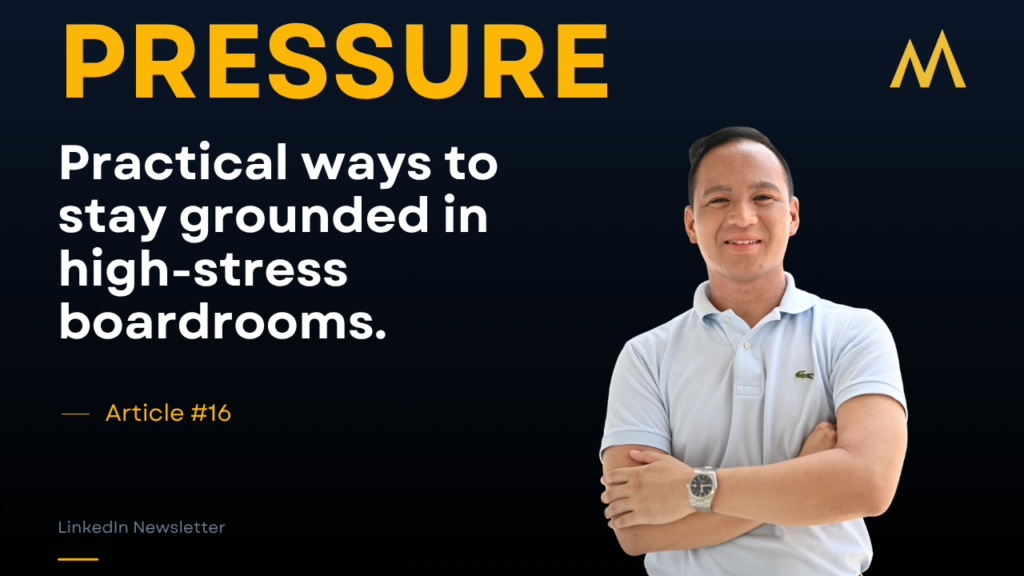
Calm Under Pressure: Practical ways to stay grounded in high-stress boardrooms

Every day, you are the final authority. But then you walk into a meeting with investors, key partners, or major clients. Suddenly, you are the one being evaluated.   This sudden shift in power is what actually causes the anxiety.   You spend all month running the company, making the hard calls, and dealing with the daily friction. Then you sit across from people who only look at the business on a spreadsheet. When they question your strategy, it feels like they are questioning your competence.   You resent having to explain your choices to people who are not doing the actual work.   Because you feel your authority shrinking in that moment, you try to force it back. You over-prepare. You try to drown the room in data just to prove that you know the company better than they do.   When they push back on a decision, you take it personally. You treat the meeting like an obstacle you have to manage. You view the conversation as a battle you have to win so you can get back to your real job.   But treating the room like an opponent is exactly what drains your power. When you fight to prove you are the smartest person at the table, you just look insecure.   Staying calm starts with understanding what the room actually needs.   The people across the table do not want a defensive operator trying to prove how hard they work. They want a peer who can look at the company objectively.   The urge to have every single metric memorized is a trap. A mature leader drops the need to be a human encyclopedia. When asked a specific question they do not know, they simply say they will find the answer and follow up. They realize that admitting you do not know a minor detail shows far more confidence than guessing.   The view on friction also has to change. When a strategy is challenged, a grounded founder stops viewing it as an insult. They realize that pushing back is just part of the process. They stop defending a flawed idea just because it was their idea.   They stop using heavy data to hide from hard conversations. Instead of bringing fifty pages of reports, they bring a few clear truths about what is working and what is broken.   When the need to prove your own value disappears, the pressure of the room drops. You stop performing for stakeholders and start discussing the business as an equal. A strong leader does not need to dominate the table.   They just need to be comfortable telling the truth at it.

Blog

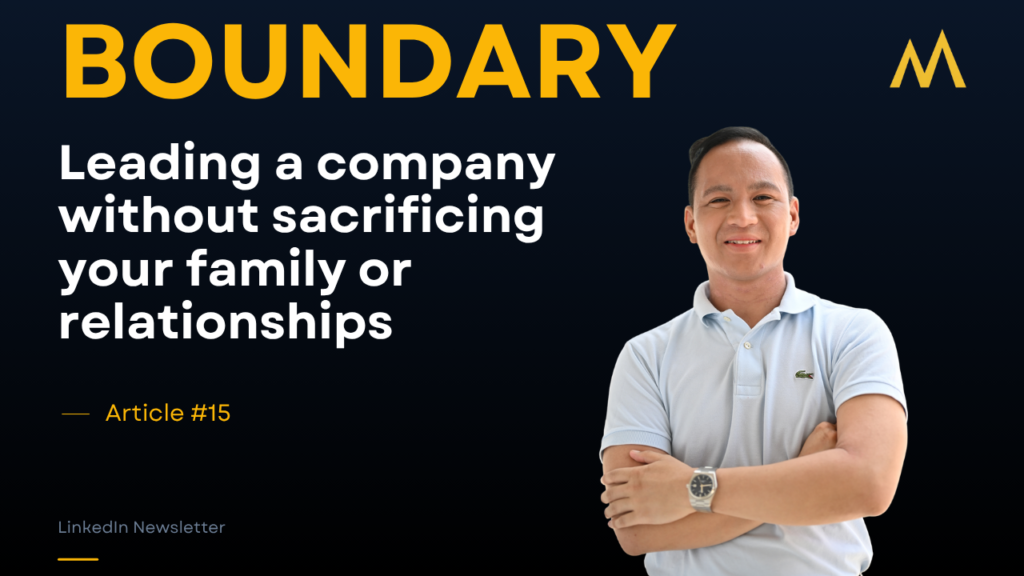
Protecting the Home Front: Leading a company without sacrificing your family or relationships

Founders use a very specific lie to justify their absence.   You tell yourself you are building the company for your family. You convince yourself that providing financial security is the exact same thing as being a good partner or parent. But while you are securing their future, you are completely missing their present.   You are physically sitting at the dinner table, but your mind is still at the office. You nod along to a conversation, but you are secretly fixing a daily issue in your head. When your family interrupts your train of thought, your first reaction is irritation.   You treat your own home like an operational delay.   The business gets your sharpest, most patient energy. Your family gets the exhausted, empty leftovers.   You expect your spouse to just understand because you carry the heavy weight of the company. But a relationship does not run on revenue. It runs on attention.   When you treat your home like a waiting room for your next work day, the people inside it slowly stop waiting for you.   Fixing this requires dropping the “provider” excuse.   A mature leader eventually realizes that a successful company cannot compensate for an empty house. The shift begins when you stop viewing your family as a distraction from your real work. You realize that protecting your relationships requires the exact same focus you give to your biggest client.   It requires the discipline of a hard boundary. It means leaving the laptop in the bag. It means putting the phone in another room and leaving it there.   At first, the disconnect feels incredibly uncomfortable. The urge to check a notification is strong because the business constantly makes you feel important and needed. But sitting in that quiet discomfort is the only way to transition out of the executive role and back into a human being.   A grounded founder learns that their corporate title holds absolutely no value in their living room. They stop expecting praise for working late. They start measuring their actual success by their physical and mental presence at home.   When the phone stays away, the tension in the house quietly dissolves. The family stops feeling like they have to compete with a company for your attention.   A business will eventually be sold, closed, or passed on.   Your family is the only thing that remains.

Blog

Staying Grounded: How to remain humble as your wealth and corporate influence grow

Success changes a founder slowly. As the business scales and your influence grows, the daily friction around you disappears. People stop telling you when your ideas are bad. Your casual suggestions suddenly become company policies. You find yourself surrounded by constant agreement. It is very easy to confuse this compliance with respect. Your ego tells you the company’s success is entirely due to your own strategy. You forget the market timing and the heavy lifting of the team executing the daily work.   This is the moment a leader disconnects from the actual operation.   You stop asking questions because you assume you already know the answers. You stop talking to the people on the front lines. You begin treating the business as a personal asset built to fund your lifestyle, rather than an organization you are entrusted to lead.   The operational cost of this shift is massive. When people are afraid to challenge a wealthy or powerful founder, blind spots turn into expensive failures. The team simply stops bringing you bad news. They let you make a mistake because disagreeing with you is a career risk.   Seeing this from the inside is difficult. When you have influence, everyone wants something from you. You cannot easily tell the difference between honest feedback and strategic flattery.   But eventually, a painful failure breaks the illusion. A major project misses the mark, and you realize your top managers knew it was a bad idea from the start. When you ask why no one warned you, the room just stays quiet. That silence is the exact moment you realize your influence has become a liability. You see that your need to be right has actually trained your staff to let you fail.   Staying grounded requires a direct change in how a leader handles authority.   True humility is not about driving a cheaper car or pretending to be just an average employee. It is a strict operational discipline. It starts with recognizing that absolute agreement in a meeting is a warning sign, not a success metric.   A mature leader begins to measure their effectiveness by the level of pushback they tolerate. They learn to sit quietly while a team member points out a flaw in their logic. They realize that protecting a culture of honesty is far more valuable than protecting their own pride.   The view on wealth and influence also changes. A grounded founder stops seeing financial success as proof that they are always right. They view it simply as the result of a system that is currently working well. The daily focus shifts from extracting value for themselves to acting as a steady steward for the people running the machine.   When the ego drops, the communication improves. The leader stops needing to be the smartest person in the room. They let go of the pressure to have every correct answer.   They realize that true respect does not come from intimidating people with a title or a bank account. It comes from the discipline to listen and the restraint to let the team execute. A strong business is not built to serve the founder’s ego.   A strong founder is built to serve the business.

Blog

Preventing Burnout: Simple daily habits to protect your long-term mental health

Burnout does not look like being tired.   It usually looks like you just do not care anymore.   You do not collapse at your desk. You just stop fighting for the small things you used to protect.   You look at a basic question from your team, and your first feeling is annoyance. You ask yourself why you have to explain the exact same task again.   The work itself has not changed. Your patience is just gone.   You are tired of being the only person who holds the standard. You are tired of being the final check for every small problem.   This is what burnout actually feels like for a founder. It feels like you built a machine that only runs if you push it.   Every time a team member asks for your approval, it feels like they are taking your energy. So, you start avoiding your own staff. You wait hours to open emails. You let small mistakes happen simply because fixing them takes too much effort.   You tell yourself the team is just not good enough. But the truth is, you built the company this way.   In the beginning, you wanted to be needed. You made sure every choice crossed your desk. Now, being needed is exactly what is draining you.   Your team is not doing this to you. They are just following the rules you set up. They wait for your answer because you taught them that their own answers are never quite right.   You cannot fix this with a vacation. A week off does not change how the team works. When you come back, they will still be waiting for you to tell them what to do.   Seeing this from the inside is hard. When you are burnt out, your pride tells you that you are just surrounded by people who do not work as hard as you do.   This is why tired founders sit down with an outside partner. Not to get a list of daily self-care habits or morning routines. But to have someone point out that your own need for control created the trap you are now stuck in.   Escaping this trap requires a complete change in how a leader views their own value.   Recovery does not begin with a week away from the office. It begins with the quiet discipline of letting people struggle. When a team member brings a problem, a recovering founder stops providing the answer. They simply ask what the team member plans to do about it.   This creates an uncomfortable silence. But in that silence, the team finally starts to think for themselves. They realize the safety net is gone, and they have to carry their own weight.   Protecting mental energy means accepting a temporary drop in perfection. It means watching small failures happen without jumping in to save the day. It requires sitting at a desk and letting an imperfect email go out, simply because the long-term lesson is more important than a flawless moment.   Slowly, the daily dynamic shifts. The team stops asking for permission to do their basic jobs. The constant interruptions slow down. The founder’s schedule begins to clear, not because the company is doing less, but because the leader is no longer the bottleneck.   Energy naturally returns when a leader steps out of the center of the operation. They stop finding pride in being the hero who fixes everything. They find actual peace in being completely unnecessary to the daily work.   A strong leader knows that their mental energy is a real business asset.   You do not burn out from working hard. You burn out from building a company that refuses to work without you.

Blog

Strategic Pause: Why taking a break is a high-yield business strategy, not a weakness

Founders hate when things get quiet.   When the business slows down, your first reaction is to panic. You assume you are falling behind. You assume your competitors are beating you. So, you immediately fill the empty schedule with new tasks.   You start a new marketing push. You change a process that was already working fine. You schedule more meetings just to make sure your team is busy.   Staying busy feels like progress. But usually, you are just creating extra work.   You tell yourself that taking a break is a sign of weakness. You think if you take your foot off the gas, the team will stop working. So you keep pushing everyone to run at maximum capacity.   But running a company this fast all the time is dangerous.   When there is no time to think, your team just reacts to whatever is in front of them. Every email is treated like an emergency. Small client issues turn into massive problems.   Your team stops caring about the big goals because they are just trying to survive the week. The work gets sloppy. Mistakes pile up. You end up working incredibly hard on things that do not actually matter.   It is hard to see this when you are exhausted. You just assume working harder will fix the stress. Stopping feels like admitting you cannot handle the job.   But eventually, you have to look at the actual results. You reach the end of a crazy quarter and realize the business barely grew. You see that all those late nights did not lead to more profit. You realize that your personal need to feel busy is exactly what is breaking your company.   Fixing this requires a complete change in how you view a break.   Taking a pause is not giving up. It is a required business strategy. It means making the hard choice to stop starting new projects so your team can actually finish the old ones.   When you finally step back, the daily panic drops. You stop fighting small fires and start looking at the real problems. You realize that putting a freeze on new ideas for a month allows your team to finally catch up.   Your staff gets to breathe. They stop waiting for you to suddenly change direction. They start fixing the systems they already use.   Your own decisions get better because you are no longer making them out of pure exhaustion. Your head clears. You realize that most of your “urgent” problems only existed because you were moving too fast.   Constant urgency is usually just fear.   Real speed does not come from rushing. It comes from knowing exactly what to ignore.   A pause is not a retreat. It is just giving yourself the time to make the right choice.

Blog

Empathetic Leadership: Making tough, high-stakes choices without losing your heart

Most leaders misunderstand empathy. They think it means being well-liked. They think it means protecting their team from discomfort. So, when a high-stakes decision has to be made, they hesitate.   You keep an underperforming employee because you know they are going through a hard time at home. You delay a necessary structural change because you do not want to upset the team. You soften a performance review because you do not want to hurt someone’s feelings.   You tell yourself you are being a compassionate leader. In reality, you are just avoiding conflict.   When you avoid a hard choice to protect one person, the rest of the company pays the price.   Your top performers have to work late to fix the mistakes you refused to address. The team loses trust in you because they see you tolerating a low standard. Misguided empathy destroys the exact culture you are trying to protect. This is where a leader must act as a steward. An operator focuses on the emotion of the person sitting across from them. A steward focuses on the survival and health of the entire organization.   True empathy is not about shielding people from reality. True empathy is absolute clarity.   It is looking someone in the eye and telling them exactly where they stand. It is making a hard cut today so the rest of the company has a secure place to work tomorrow.   Making tough choices does not mean you have to lose your heart. It means your heart has to be big enough to carry the weight of the whole team, not just the person who is struggling.   Seeing this clearly while you are carrying the emotional weight of a decision is incredibly difficult. You cannot easily separate your personal guilt from the structural needs of the business. Your ego wants to be the good guy.   This is why wise leaders talk through these choices with an objective partner. Not to get permission to be ruthless. But to have someone point out exactly where personal guilt is masquerading as good leadership.   A mature leader knows that the right choice will often cause temporary pain. But they make it anyway. Because protecting people from the truth today only guarantees a much bigger failure for everyone tomorrow.

Blog

The Power of “No”: Saying no to distractions to protect your core business

Every leader knows they need to focus.   But saying “yes” is very addictive. It feels like forward motion. It feels like progress.   In reality, it is usually just a way to hide.   Founders rarely say yes to a new idea because it is too good to pass up. They say yes because the main business has become boring.   Growing your main service is just repeat work. Fixing a broken process is hard and dull. Managing people through a tough week is uncomfortable.   But starting a new project is exciting.   It brings back the fun of the early days. It gives you a reason to skip the heavy, boring work of running the company. Your ego tells you this distraction is actually innovation.   But while you get the thrill of the new idea, your team pays the actual price.   They are already stretched thin running the daily business. When you suddenly add a new product or chase a new type of client, their focus breaks. Time and energy are pulled away from what actually makes money.   Work on the main business slows down. Quality drops. Deadlines slip.   Your team does not burn out from working hard. They burn out from constantly changing directions.   They lose trust in you because they see the foundation cracking while you chase a shiny new object.   This is where a leader must act like a steward.   An operator loves the thrill of the launch. A steward protects what has already been built.   Saying “no” is not a time management trick. It is the main job of a leader. It is the discipline to protect the time and energy of your people.   You have to be willing to reject a good idea simply because it is a distraction. You have to sit in the discomfort of doing the routine work.   Seeing your own choices clearly is hard when every new idea feels urgent. You cannot easily tell the difference between a smart move and a personal distraction.   This is why leaders often sit down with an objective partner. Not to check the math on the new idea. But to have someone point out the exact problems you are trying to ignore by starting it.   Protecting the core business requires a shift in how a leader views opportunity.   A new idea is no longer seen as just potential revenue. It is recognized as a direct tax on the team’s current capacity. A strong leader calculates exactly what will break in the main business before they ever look at the upside of a new venture.   When the excitement of a new direction hits, the strongest countermeasure is simply time. Putting an exciting idea in a drawer for thirty days changes the perspective. Without the immediate rush of adrenaline, the idea often loses its appeal. It quickly becomes clear whether the “opportunity” was a real strategy or just a temporary escape from a hard week.   The definition of innovation also has to mature. It stops being about launching new products or entering new markets just to feel motion. Innovation becomes the quiet work of mastering the current system. It is finding pride in an efficient, unbroken delivery process rather than a chaotic new launch.   When leadership stops pivoting, the team finally exhales. They stop bracing for the next sudden change and start optimizing the work right in front of them. Trust returns because the team sees that their time and energy are actually being protected. The culture stabilizes simply because the leader decided to stay in the room and do the unglamorous work.   A mature leader knows that lasting growth is often boring.   It does not come from constantly starting new things. It comes from having the restraint to say no.   And the discipline to finish what you already started.

Blog

Managing Growth Anxiety: How to scale your business without losing your peace of mind

Growth anxiety is rarely about the volume of work. It is usually about a sudden loss of relevance. In the early days, your value as a founder was tied directly to your hustle. You put out the fires. You closed the difficult deals. You saved the accounts. The company survived entirely because of your sheer force of will. But scaling changes the math. A growing business no longer needs your hustle. It needs your restraint. And for a leader used to operating in a constant state of urgency, restraint feels exactly like failure.   When operations begin running smoothly without your direct involvement, you do not feel peace. You feel anxious.   You sit at your desk and feel like you are missing something. So, you start looking for problems to solve. You insert yourself into meetings you do not need to be in. You ask for detailed updates on projects that are already on track. You rewrite emails that were already good enough.   You convince yourself you are protecting the standard. In reality, you are just manufacturing urgency to feel essential again.   This is where a founder’s internal anxiety turns into an operational bottleneck.   When you manufacture urgency, you disrupt execution. Your team stops focusing on the market. They start focusing entirely on managing your anxiety.   They learn to delay basic decisions until you weigh in. Not because they need your strategic insight, but because they know you will likely change the plan anyway just to leave your fingerprint on it.   Growth anxiety happens because you are trying to run a mature organization using the psychology of a startup founder.   Scaling requires a difficult realization. The specific traits that helped you survive the first three years are the exact traits that will break the company in year five.   The operator has to step back so the steward can step forward.   The operator measures their worth by how many problems they personally solve. The steward measures their worth by how many problems the system solves without them.   It is incredibly difficult to see this transition while sitting inside the pressure of the company. You cannot easily tell the difference between holding a high standard and feeding your own need for control. Your ego will always disguise interference as leadership.   This is why executives often utilize an objective partner. They do not need a consultant to build a new organizational chart. They need a space to look at their own leadership patterns without getting defensive. They need someone to point out where their personal need to feel vital is actively slowing the company down.   Breaking this cycle requires a quiet shift in discipline.   It starts with changing what actually gets measured. A mature leader stops finding value in how busy they are, and starts looking at the autonomy of their team. If a department cannot make a basic decision alone, it is a signal that the system is broken. True delegation is handing over authority, not just a list of tasks. It means accepting that someone else will do the work differently than the founder would. It means allowing small mistakes to happen, simply because that is the only way a team learns how to carry the weight.   When the anxiety hits and the urge to step in feels overwhelming, the strongest move is often just a pause. Leaving a critical email sitting in drafts for twenty-four hours usually reveals something important. The team will often spot the error and fix it themselves. When they do, trust builds. The anxiety quietly drops.   The founder’s job description eventually changes. It moves away from managing the daily process and focuses entirely on setting absolute clarity on the standard. When the outcome is clear, the daily process manages itself.   This transition requires sitting in the discomfort of watching people figure things out. It requires a leader to find their identity in building other leaders, rather than just being the hero. Growth does not break businesses. Founders who refuse to outgrow their early habits break businesses.   Peace of mind during a growth phase does not come from holding onto the details. It comes from accepting that the business has finally outgrown your hustle.

Blog

Leveraging contradictory viewpoints to find business blind spot

The executive meeting finishes exactly on time. Every milestone receives a nod of approval. There is no debate and no visible friction.   You feel validated because the team seems perfectly aligned. But absolute agreement is exactly where the real risk begins.   Blind spots do not grow in rooms where people are actively arguing. They grow when people only say what leadership wants to hear.   If you have a track record of success, your team will eventually stop questioning your assumptions. They assume you know something they do not, or they decide it is safer to agree.   Leaders become dangerous to their own organizations when nobody can challenge their thinking. Their view of the company simply disconnects from the daily reality of the floor.   Hearing pushback on a strategy you built is uncomfortable. Your first reaction is usually defensive.   But the goal of a leadership team is not constant agreement. The goal is to find out what you are missing before it costs the business.   Mature leaders treat dissenting opinions as data points. Sometimes the person who frustrates you most is just exposing a weakness in your system.   An employee questioning a process is rarely trying to sabotage it. They are just highlighting a gap. Not every criticism is an attack.   Different departments experience completely different realities. Sales feels market pressure, operations deals with capacity limits, and finance protects cash.   When these departments disagree, it is not dysfunction. It is just different functions protecting different assets.   If you only listen to sales, you will overpromise and break your delivery. If you only listen to operations, you will build a process for a product nobody wants to buy.   Opposing viewpoints reveal operational gaps before they break the business. But teams lose trust the moment leadership asks for honesty and then punishes it.   It only takes one instance of an executive getting defensive for the room to shut down. People watch how you handle bad news before they decide to tell you the truth.   If you dismiss a warning, the team learns that survival requires silence. They stop telling you when deadlines are unrealistic. They let you walk into a mistake because correcting you is too risky.   A strong culture allows respectful disagreement. To build that, a leader must admit they do not hold all the answers.   Ego protects being right in the moment. Stewardship protects the business.   When you prioritize stewardship, you stop caring who has the right idea. You only care that the execution works.   Inviting viewpoints does not mean running the company by committee. You cannot weigh every opinion equally without paralyzing the operation.   Wise leaders simply learn how to filter the noise. If one person complains, it might be a personal preference. If multiple departments point out the same friction, it is an operational reality.   Navigating this feedback under daily pressure is difficult. You cannot easily see your own blind spots because they sit directly behind your assumptions.   Sometimes, an outside perspective simply holds up a mirror. It provides a space to look at the business without your own ego in the way.   Leadership requires the restraint to listen, the clarity to filter, and the discipline to execute.

Blog

How to know if you made the “right” choice or just the “easy” one

The relief that follows a decision can be misleading. You sign the agreement, the immediate friction stops, and you assume the problem is solved. It is easy to assume the problem is solved just because the conflict ended.   But that initial calm is usually just the absence of confrontation. A few days pass, and you are left wondering if you actually fixed the structural issue or just delayed it.   Evaluating a choice requires looking at exactly where it came from. An easy choice has a predictable signature. It protects your comfort, your ego, or your timeline. It allows you to bypass accountability and avoid a hard conversation today.   Sometimes an easy choice disguises itself as an opportunity. A client offers a contract slightly outside your core focus. It feels like progress simply because it is an open door.   But not every open door is an assignment. Some are just distractions.   Saying yes is easy because the momentum is already there. Backing out later is what creates the operational friction. This is where stewardship replaces convenience.   You agree to terms out of frustration or fatigue. The immediate pressure stopped.  The problem remained.   You just guaranteed an execution failure three months down the road. The right choice rarely offers immediate relief.   It usually introduces an added layer of responsibility or a direct operational sacrifice. You trade today’s comfort for tomorrow’s sustainability. You have to deliver news your team does not want to hear.   Holding a standard often makes you unpopular in the short term. Founders mistake that internal resistance for a sign they made a mistake.   But some decisions are heavy simply because the stakes are high, not because they are wrong. The right choice aligns with your standard, even when it is financially costly. Walking away from revenue to protect your culture means the numbers take a hit this quarter.   You will have to explain the margin drop to the board. But the operational integrity stays intact.   To understand a decision, look closely at the mindset that drove it. Did this decision come from fear, pressure, pride, or clarity?   If your identity as a leader is tied entirely to immediate results, you cannot think long term. Fear of a missed target dictates the pivot.   Pride prevents you from admitting a delivery process is fundamentally broken. Decisions made from these states are purely reactive. They defend a position rather than build a sustainable asset.   Stewardship forces a slower, more deliberate process. It does not ask what protects your reputation this month. It asks a very direct question.   What is the most responsible thing to do for the organization? It forces you to weigh the secondary consequences and the long-term impact on your execution. When you operate as a steward, short-term compromises lose their appeal.   Evaluating your own decisions from inside the company is difficult. It is hard to separate personal anxiety from actual data. You cannot easily see blind spots in a strategy you created.   This is why leaders often need an outside perspective to simply hold up a mirror. Not to provide a management framework, but to ask if fear or pride dictated the last move.   If you chose the easy path, the avoided conversation eventually turns into cultural division. The small operational shortcuts turn into technical debt.   But if you chose the responsible path, the team aligns around the standard. Trust deepens.   The path of responsibility requires friction upfront. But it is the only way to build a company you actually want to lead.

Scroll to Top